

What Is an AI PC? Why It’s Redefining the Future of Computing
Over the past few years, artificial intelligence has rapidly transitioned from remote cloud-based servers into everyday edge devices. Among these technological shifts, the emergence of the AI PC (Artificial Intelligence Personal Computer) stands out as the most significant hardware evolution in the consumer electronics and portable computing industry in decades.
For B2B buyers, IT distributors, wholesalers, and computer hardware resellers, understanding what an AI PC is goes far beyond keeping up with fast-moving technology trends. It is about anticipating the next major wave of global hardware demand, identifying shifting market requirements, and positioning your product catalog and inventory far ahead of the curve.
The Evolution of Personal Computing: From Traditional Desktops to Intelligent Machines
To fully grasp the magnitude of the current shift toward AI PCs, it is helpful to look back at how personal computing has evolved over the past several decades. From the introduction of the graphical user interface (GUI) to the mobile revolution and the widespread adoption of cloud computing, every major milestone has redefined how humans interact with technology.
The Limitations of Cloud-Centric AI
For the initial wave of the generative AI boom, heavy processing tasks were handled almost exclusively in massive data centers. While this approach enabled powerful applications like large language models (LLMs) and advanced image generators, it exposed several fundamental bottlenecks:
-
- High Latency: Sending prompts to remote servers and waiting for a response introduces unavoidable network delays.
- Bandwidth Dependence: Continuous cloud communication requires robust, stable internet connectivity, limiting performance in mobile or remote environments.
- Data Privacy Risks: Transmitting sensitive enterprise data, financial records, and personal files to third-party cloud servers creates significant compliance and security vulnerabilities.
- Operational Costs: Cloud providers face immense energy and infrastructure costs to sustain millions of concurrent AI queries.

The Shift Toward Edge AI and On-Device Processing
To overcome these obstacles, the technology industry has embarked on a major shift toward “Edge AI”—processing AI workloads locally on user devices. This architectural transformation embeds intelligent capabilities directly into the hardware in your hands, thereby eliminating the reliance of real-time tasks on cloud infrastructure. The AI PC represents the ultimate physical embodiment of this industry-wide transformation.
What Exactly Is an AI PC? Decoding the Hardware Architecture
At its core, an AI PC is a personal computer equipped with specialized, dedicated hardware designed specifically to run artificial intelligence and machine learning workloads locally, rather than relying entirely on remote servers.
While traditional PCs handle general computing tasks primarily through a Central Processing Unit (CPU) and a Graphics Processing Unit (GPU), an AI PC integrates a third critical processor: the NPU (Neural Processing Unit).
The Power of the Heterogeneous Computing Trio
A true AI PC relies on a collaborative, heterogeneous computing architecture comprising three core pillars:
-
- The CPU (Central Processing Unit): Manages scalar tasks, general system operations, and standard application execution.
- The GPU (Graphics Processing Unit): Handles parallel processing, rendering, and heavy computational math, which historically served as the primary engine for early machine learning tasks.
- The NPU (Neural Processing Unit): A specialized processor built from the ground up to accelerate AI algorithms—such as LLMs, computer vision, audio processing, and real-time generative tasks—with extreme energy efficiency.

By offloading repetitive AI algorithms from the CPU and GPU to the NPU, the entire system operates with remarkable power efficiency, allowing laptops to execute complex intelligence tasks without drastically draining battery life or generating excessive thermal heat.
AI PC vs. Traditional PC: Key Differences Every B2B Buyer Should Know
When communicating with downstream retail partners, corporate clients, or repair shops, B2B suppliers must clearly articulate why AI PCs represent a generational leap rather than a mere spec bump.
1. Local Processing Power vs. Cloud Dependency
Traditional PCs lack the localized silicon required to execute complex machine-learning models locally. As a result, they act as passive terminals waiting for cloud servers to do the heavy lifting. In contrast, an AI PC can run advanced AI models entirely offline, ensuring instant responsiveness regardless of network conditions.
2. Uncompromising Data Privacy and Enterprise Security
Enterprise buyers are notoriously protective of their proprietary data. AI PCs perform data analysis, document summarization, and local pattern recognition directly on the device’s storage and memory. Because sensitive corporate insights never leave the physical machine, security risks are minimized, making AI PCs vastly more attractive for corporate procurement departments.
3. Energy Optimization and Thermal Efficiency
Older architectures forced CPUs and GPUs to spike to maximum clock speeds to handle parallel AI computations, leading to rapid battery depletion and noisy fan activity. NPUs are engineered specifically for low-power neural network calculations, providing smooth background intelligence while preserving system stability.

4. A Paradigm Shift in User Experience
The interaction model is changing from intent-to-action search to proactive assistance. Instead of opening multiple applications to format data, translate languages, or generate reports, an AI PC integrates system-wide intelligence that executes workflows natively across software suites.
Why the AI PC Revolution Matters for B2B Sourcing, Wholesalers, and Resellers
For wholesale distributors, hardware manufacturers, and component suppliers, the mainstream adoption of AI PCs is not a distant future concept—it is a present-day commercial reality that dictates supply chain strategies.
The Impending Global Replacement Wave
As enterprises across finance, healthcare, education, and creative industries upgrade their office infrastructure to support localized AI software (such as Copilot+ ecosystems and localized enterprise models), legacy laptops are rapidly facing technological obsolescence. This transition will trigger a massive, sustained global replacement wave, creating high-volume procurement opportunities for forward-thinking distributors.

Cascading Impacts on Component Quality and Hardware Standards
The introduction of high-performance NPUs and sustained high-load workloads fundamentally changes the physical demands placed on notebook hardware. Sourcing teams must recognize that AI PCs require robust supporting ecosystems:
-
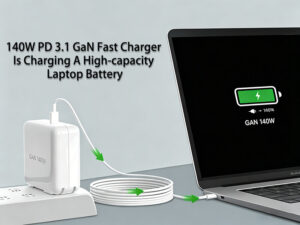
- Advanced Power Delivery (PD): Higher peak processing loads require smart, stable power adapters that can dynamically adjust wattage without risking system instability.
- High-Density Battery Cells: To support intensive workloads without compromising mobility, laptops demand superior Li-Polymer cells with enhanced thermal management and overcharge protection.
- Rigorous QC and Aging Standards: Because AI PCs operate under sustained thermal and electrical stress, manufacturing partners must enforce strict quality control and aging tests to ensure long-term reliability.

👉 Deep Dive: Want to learn how these advanced hardware shifts directly impact battery performance, power architecture, and procurement metrics? Read our comprehensive industry guide: [The Impact of AI PC on Laptop Battery Life | B2B Sourcing Guide].
Navigating the Future of Tech Hardware Distribution
The technological landscape is shifting at an unprecedented pace. The rise of the AI PC is transforming what users and enterprises expect from their portable computers, shifting the competitive advantage toward brands and suppliers who prioritize performance, efficiency, and reliability.
For B2B partners, wholesalers, and tech accessories suppliers, recognizing this transformation early is the key to capturing high-value market share. By staying fully informed on processor evolution, aligning inventory with high-performance power solutions, and partnering with verified manufacturers who maintain rigorous quality standards, your business can successfully navigate and capitalize on the future of computing.